Do We Really Need Gloves? A Campaign That Changed Thinking Across South West Healthcare
South West Healthcare's innovative 'Gloves On, Gloves Off,' campaign demonstrated how a simple change can improve safety, reduce waste, and engage staff in meaningful quality improvement.
In this Member Spotlight, we learn how South West Healthcare used collaboration, education, and evidence-based practice to reshape attitudes towards glove use and support lasting behaviour change.
Can you tell us about South West Healthcare?
South West Healthcare is a subregional health service located in southwest Victoria, providing a comprehensive range of health care services to the 110,000 people who live in Warrnambool, Corangamite, Glenelg, Moyne and Southern Grampians. Our mission is to improve the health and well-being of South West Victorians by partnering with them, their communities, and other providers to deliver high-quality healthcare with a future-focus through our engaged, empowered and motivated workforce.
What values guide your approach to care?
Our approach to care is underpinned by five core organisational values:
- Excellence – we ensure every interaction is of the highest standard, every time. We do not compromise on quality.
- Integrity – we are transparent and ethical in all that we do. We are accountable for our decisions and actions. We embrace honest feedback and act on it.
- Care – we put the person at the centre of everything we do. We are compassionate and responsive to the needs of consumers at our service, their families, our staff and volunteers.
- Respect – we behave in a manner that demonstrates trust, inclusion and mutual understanding. We respect diversity and communicate openly with consideration of others.
- Leadership – we lead by examples and empower everyone. We are strategic, responsive and resilient.
Can you tell us about the “Gloves On, Gloves Off” campaign and what inspired the team to focus on reducing unnecessary glove use?
'Gloves On, Gloves Off’ was developed as an innovative joint Environmental Sustainability and Infection Prevention initiative across all South West Healthcare (SWH) campuses to reduce inappropriate or overuse of non-sterile blue gloves and to improve hand hygiene. This project is based on evidence that when there is low risk of exposure to blood, body fluid or hazardous substances, good hand hygiene is completely effective at keeping healthcare workers safe. ‘Gloves On, Gloves Off’ resulted in a 17% reduction in glove use over a twelve-month period, keeping 400,000 individual gloves from landfill, avoiding associated emissions and reducing hospital acquired infection rates.
In April 2020, during the initial stages of the COVID-19 response, the Victorian Government adopted the World Health Organization’s ‘Interim guidance for the rational use of personal protective equipment (PPE) for corona disease 2019’. This included the addition of single-use gloves as part of the recommended Department of Health and Human Services (DH) ‘Coronavirus (COVID-19): Healthcare Worker PPE guidance for performing clinical procedures’ when caring for a patient suspected or confirmed Coronavirus (COVID-19).
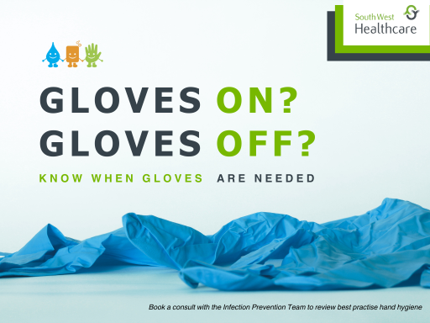
Pictured: Gloves On, Gloves Off Campaign Promotional Material
Despite subsequent changes in DH PPE protocol removing the standard inclusion of gloves, the ever-changing protocols lead to elevated levels of PPE anxiety, with staff second guessing themselves about how to keep safe from contracting COVID at work. The wearing of PPE and masses of clinical and general waste generated at South West Healthcare (SWH) contributed to an atmosphere of staff fatigue.
Elevated use of PPE continued beyond COVID-19 despite evidence to the contrary: there is no better barrier to infection than intact skin. Evidence from the National Hand Hygiene Initiative indicates that non-sterile gloves are commonly miss or overused in clinical work and that healthcare workers are less likely to adhere to the ‘Five Moments of Hand Hygiene’ when wearing non-sterile gloves. Indeed, SWH hand hygiene auditing has recorded incorrect glove usage leading to missed hand hygiene opportunities, increased risk of infection transmission, and increased negative environmental impacts.
In 2022, SWH’s Manager Infection Prevention attended the major UK Infection Prevention and Control (IPC) conference and visited National Health Service (NHS) hospitals as recipient of SWH’s annual AEW Matthews Travelling Scholarship for professional development. The ‘Gloves Off’ campaign being utilised at Guy’s and St Thomas’s hospitals in London was presented by Dr Jon Otter at the conference, with similar effective campaigns across the NHS. Dr Otter coined the phrase ‘yellow washing’ (yellow the colour for clinical waste), with infection prevention being used as an excuse to not implement sustainable practices. He argued that, rather than being diametrically opposed to each other, sustainability and infection prevention could align and lead to mutually beneficial outcomes.
How did you engage staff and encourage them to rethink when gloves were truly needed?
The project team included members of the Environmental Sustainability and Infection Prevention Teams who determined that a stated priority of reducing waste to landfill (including clinical waste), a key target in the SWH Environment Management Plan 2020-2024, could be achieved through the focus on a single high-use item. This was a way to cut through and engage a fatigued workforce, with a gentle invitational approach to alleviate the perceived anxiety of more change, and a pathway to positively impact the waste to landfill.
In October 2023, a multidisciplinary project team was convened to run the SWH project ‘Gloves On, Gloves Off’, with evaluation of the initial 12-month campaign completed in February 2025.
The team agreed to aim towards measurable results that:
- Improve hand hygiene compliance
- Reduce hospital acquired infections
- Reduce unnecessary use of non-sterile blue gloves
- Improve healthcare worker risk assessment confidence and understanding
- Design and deliver a low cost, simple program that can be used across other healthcare settings
- Improve SWH environmental impact
- Engage all of staff in a project with shared goals to which everyone could contribute and demonstrate positive workforce feedback.
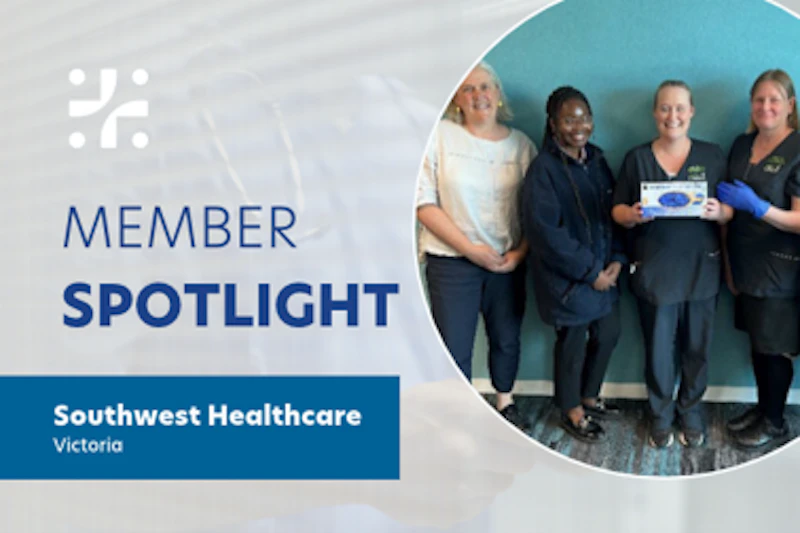
.png "IA-Courses-Social-Media-(18).png") Pictured - Left: Staff at Southwest Healthcare, Right: Team accepting award at Victorian Public Healthcare Awards 2025
Pictured - Left: Staff at Southwest Healthcare, Right: Team accepting award at Victorian Public Healthcare Awards 2025SWH then developed the ‘Gloves On, Gloves Off’ campaign in alignment with best practice behaviour change strategies (Behaviour Works EAST framework – Easy, Attractive, Social and Timely).
- The focus on one item was identified as the most constructive means of approaching reductions in clinical waste generation for an audience that had been exhausted from continually changing guidance around PPE.
- Prior to the campaign commencing, preparation included key message development (around keeping staff and patients safe), background data, ward poster development and approvals sought from both Infection Prevention and Waste Working Groups.
- The campaign was launched during World Handwashing Day with face-to-face clinical education offered to each of the 21 high use areas.
- Importantly, when making meeting times, managers were engaged to provide early advice on ward/department specific relevant overuse areas.
- During education, staff raised questions to clarify correct usage scenarios and also provided helpful feedback such as different branded gloves were actually different sizes, leading to wastage as staff tried on, then discarded, multiple pairs to find the right fit.
- All questions were welcomed, and impromptu visits continued the conversations for the 12 months following the campaign launch.
- Monthly usage was monitored, with sites achieving more than 10% reductions in blue glove use after six months receiving particularly tailored feedback to be included as a quality improvement initiative for our short notice accreditation cycle.
While a project barrier was staff exhaustion around PPE messaging frequently changing during the pandemic and the fact that some degree of behaviour change was required, the project leaders report that, from across the service, they enjoyed overwhelmingly positive support. The beauty of a simple campaign provided a means for staff to navigate together into a COVID new normal.
Staff are more confident now applying more rigour to PPE resources and clinical staff are more comfortable to risk assess whether or not to use gloves as PPE.
The engagement of all departments, both clinical and non-clinical, in reviewing their own areas for improvement and tapping into broad discomfort with levels of waste being generated during COVID, has led to a range of workforce, quality, safety and sustainability benefits.
Looking back on the campaign, what were the key lessons learned, and what advice would you share with other healthcare organisations looking to drive similar change?
A key lesson was the value of bringing Infection Prevention and Environmental Sustainability teams together around a shared goal. Focusing on environmental impact and staff safety, rather than cost savings, helped engage frontline staff and build widespread support.
Keeping the initiative simple and tangible was also critical. By focusing on one high-use item, the team delivered a quick win that staff could easily understand and act on. Our advice to other organisations is to start small, make the benefits meaningful to staff, and work collaboratively across teams to create lasting change.
Do you have any advice for other ACHS Members on their accreditation journey?
Start with simple, practical quality improvement projects that staff can easily understand and support. Strong engagement across a range of teams helps build momentum and makes change more sustainable.
It's also important to evaluate projects once they are completed, continue monitoring key indicators through relevant committees, and provide ongoing education for new staff. Collaborative approaches can be particularly effective, as they share the workload, maintain momentum, and reduce the fatigue that can come from a single team carrying a message on its own.
References
- World Health Organization’s (WHO) ‘Interim guidance for the rational use of personal protective equipment (PPE)for corona disease 2019’.
- Department of Health and Human Services Coronavirus (COVID-19): Healthcare Worker PPE guidance for performing clinicalprocedures.23rd April 2020.
- Australian Commission on Safety and Quality in Health: National Hand Hygiene Initiative
- Behaviour Works (2024). Behaviour Change Workbook. Monash University