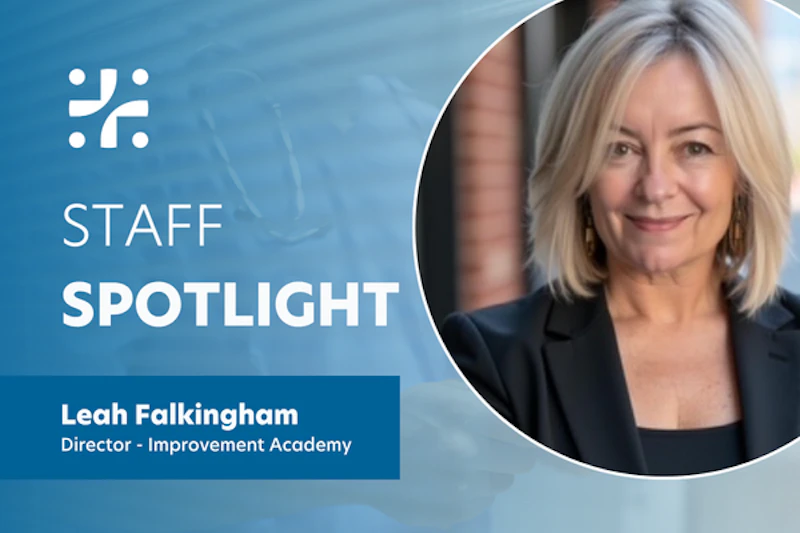
Meet Leah Falkingham – Director of the ACHS Improvement Academy
Welcome to our Staff Spotlight where we introduce our great team who work tirelessly to support ACHS Members and the broader healthcare community.
In this edition, we learn more about Leah Falkingham, Director of the ACHS Improvement Academy (IA). Since joining the IA, she has brought fresh energy and a positive outlook to the team. Her expertise lies in transforming organisations into adaptive learning environments.
Can you tell us about your career journey to date and what drew you to take on the role as Director of the ACHS Improvement Academy?
At the heart of my career is a natural curiosity and a strong commitment to continuous improvement. Across medical education, learning design, healthcare communications and academic research, a consistent thread has been building knowledge and capability that genuinely improves outcomes. I’ve been fortunate to work across health services, NGOs, universities, global healthcare organisations and industry, often at points of transformation or growth. Those experiences, supported by continuous learning and reflective practice deepened my conviction that high‑quality education is one of the most powerful levers for safer, more reliable and more compassionate care.
The Improvement Academy brings all of that together. It sits at the intersection of quality, capability and system improvement, with a trusted national brand and deep reach into the health system. I feel privileged to lead a great team of people, translating evidence, insight and innovation into practical learning that helps people across healthcare make a genuine difference.
You bring more than 15 years of experience in healthcare workforce capability and education innovation across global health systems. What does effective leadership mean to you?
For me, effective leadership is values‑driven, human and deeply practical. I’ve learned as much from inspiring leaders who lead with clarity, generosity and curiosity as I have from seeing the limitations of command‑and‑control or ego‑led approaches.
The best leaders create conditions where people can think well, speak up and continuously improve. They balance ambition with psychological safety, hold clear expectations, and model the behaviours they want to see. I strongly believe leadership is less about having all the answers and more about asking the right questions and then enabling others to solve meaningful problems together.
That philosophy underpins how I lead the Improvement Academy: with collaboration, transparency and a strong focus on outcomes that matter to patients, learners and organisations.
From your perspective, what are the most important trends or shifts currently influencing quality in healthcare?
Several major shifts are converging. Artificial intelligence is a clear game‑changer. In healthcare, its potential is significant, but so are the governance, safety and ethical considerations. We are already supporting organisations to build AI capability through a strong clinical governance lens, helping leaders move beyond hype to responsible and practical application.
Healthcare sustainability is another critical and closely related issue. Workforce burnout, resource constraints and environmental impact are no longer peripheral concerns, they directly affect quality and safety. Building resilient systems and people is now central to delivering consistent, high‑quality care.
Alongside these emerging areas, the fundamentals remain essential. Strong clinical governance, effective incident management, open disclosure, improvement science and genuinely patient‑centred care continue to be critical enablers. Improvement Academy evolution is not about replacing the basics, it’s about strengthening them while preparing for what’s next.
What role do you see the Improvement Academy playing in shaping the future of healthcare capability and practice?
The Improvement Academy has a unique opportunity to shape the future of healthcare capability in three ways.
First, by becoming truly learner‑centric. This means designing education around real needs, real contexts and real constraints. Providing the right learning support at the right moment, whether that’s at the frontline of care, online or in virtual classrooms.
Second, by bringing innovation and thought leadership to priority capability areas. This includes AI‑enabled learning, building modular flagship programs, micro‑learning and scalable pathways that maintain quality while increasing reach and impact.
Finally, by strengthening partnerships, with our collective subject matter experts, strategic allies and organisations, to co‑design learning that is practical, evidence‑informed and future‑ready. Our goal is to help individuals, teams and systems move confidently from compliance to continuous improvement, in ways that are measurable, sustainable and aligned to better patient outcomes.
The Academy is well placed to be not just a provider of education, but a trusted partner in building the capabilities healthcare needs now and into the future.
Thank you, Leah, for sharing your insights and experience with us. We look forward to bringing you further Staff Spotlight articles in the future and showcasing the incredible talent that we foster at ACHS.